%%USERNAME%%    %%ACCWORDS%% %%ONOFF%% |


 Items to fit into your overhead compartment |
|
Carrion Luggage 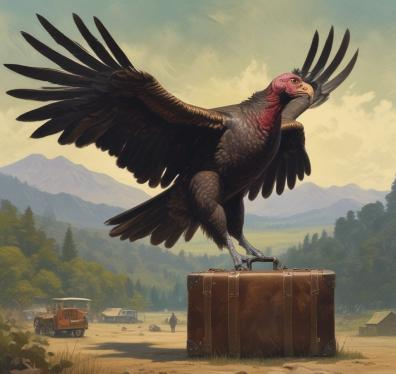 Native to the Americas, the turkey vulture (Cathartes aura) travels widely in search of sustenance. While usually foraging alone, it relies on other individuals of its species for companionship and mutual protection. Sometimes misunderstood, sometimes feared, sometimes shunned, it nevertheless performs an important role in the ecosystem. This scavenger bird is a marvel of efficiency. Rather than expend energy flapping its wings, it instead locates uplifting columns of air, and spirals within them in order to glide to greater heights. This behavior has been mistaken for opportunism, interpreted as if it is circling doomed terrestrial animals destined to be its next meal. In truth, the vulture takes advantage of these thermals to gain the altitude needed glide longer distances, flying not out of necessity, but for the joy of it. It also avoids the exertion necessary to capture live prey, preferring instead to feast upon that which is already dead. In this behavior, it resembles many humans. It is not what most of us would consider to be a pretty bird. While its habits are often off-putting, or even disgusting, to members of more fastidious species, the turkey vulture helps to keep the environment from being clogged with detritus. Hence its Latin binomial, which translates to English as "golden purifier." I rarely know where the winds will take me next, or what I might find there. The journey is the destination. |
| Today's link is from The Guardian, and it's long. Just a warning for short attention spans. At least it's text and not video. Apocalypse no: how almost everything we thought we knew about the Maya is wrong  For many years the prevailing debate about the Maya centred upon why their civilisation collapsed. Now, many scholars are asking: how did the Maya survive? Though I hate that the headline leans into the "apocalypse" nonsense, and with a terrible pun no less, I wanted to know what they had to say. (Yes, I used a terrible pun for this entry title, too. I never said I wasn't a hypocrite.) Thanks to technological advances, we are entering a new age of discovery in the field of ancient history. Improved DNA analysis, advances in plant and climate science, soil and isotope chemistry, linguistics and other techniques such as a laser mapping technology called Lidar, are overturning long-held beliefs. Nowhere is this more true than when it comes to Maya archaeology. In other words, we move forward to look backward, which gives us tools to move forward. That is, assuming you view time as a linear thing with the future ahead of us. I did a whole entry on that a little while ago ("Fun Times" ), and the irony is that it doesn't appear that the Maya civilization had a linear view of time. You know, what with their whole famous calendar thing, which I'll get to in a little bit.When Estrada-Belli first came to Tikal as a child, the best estimate for the classic-era (AD600-900) population of the surrounding Maya lowlands – encompassing present day southern Mexico, Belize and northern Guatemala – would have been about 2 million people. Today, his team believes that the region was home to up to 16 million. That is more than five times the area’s current population. That's a hell of a difference. By way of comparison, that's almost twice the population of New York City. A bit more spread out, though. Think of it more as: almost twice the population of Virginia. This is how science works. And that's a good thing. Some Maya cities were established hundreds of years before the founding of Rome, and they included significantly larger architecture that still stands. Both cultures developed sophisticated astronomy, mathematics, writing and agriculture, as well as elaborate trade arrangements across vast cosmopolitan lands. I'm still not convinced that Rome was all that great at math. Or maths, as The Guardian would spell it. Outsiders’ power over the story of the Maya is written into the people’s very name. After their arrival in the early 1500s, the Spanish named local populations “Maya” after the ruined city of Mayapán in present day Mexico. Yet the Maya never saw themselves as one people and were never governed under one empire. They spoke many languages – 30 of which are still around – and belong to an intricate mix of cultures and identities. This is, I think, similar to how they used to think of North American natives as "Indians" without much regard for the nations, tribes, clans, etc. that made up the diverse pre-Columbian population. Or how people think of "Africa" as one place while "Europe" is many places. Over time, some observers spread pseudoscientific stories claiming that Maya temples were more likely to have been built by aliens than by ancestors of local people. (Vikings, Mormon Nephites and other mysteriously vanished civilisations have also been dubiously credited with building the ancient sites.) Yes, because clearly, people with noticeable melanin in their skin couldn't possibly have achieved anything of greatness. Hence the "theories" about Maya, or about ancient Egyptians for that matter. Also, I thought we were done calling them "Vikings." Subsequent large-scale mappings led to Estrada-Belli’s estimate that between 9.5 and 16 million people once lived in the Maya lowlands. He calls the lowlands in the 700s a “continuously interconnected rural-urban sprawl”. This was a cosmopolitan region with high degrees of trade and settlements interconnected by a close web of causeways and roads. So, apparently, by the time Europeans showed up almost a thousand years after, most of it was reclaimed by the jungle. The ancient Maya did not use pack animals, or carriage wheels. Everything that was built and traded had to be carried by human force alone. The bit about carriage wheels is pretty famous. At least, I've known about it for a very long time. There's a lot of speculation about why, some of it centered on things like the above: that they were too primitive to invent such things. And yet, there's another possible explanation: that the wheel was entirely too sacred to use for mundane tasks such as carrying burdens. Calling something like that "sacred" may strike you as primitive, too, but from an outsider's perspective, some of the things you consider sacred are mere mundanities. Now... there's a lot more at the link. I did say it was a long read. The article itself says it's a long read. But if all you know about the Maya is the calendar thing, or the wheel thing (which I believe might be related), it's worth the time. |
 un:
un:  View Portfolio
 Visit Notebook
 Send Gift Points
 Awards
 Badges



 Community Feed
 Puzzle Hub
 General Discussion
 Sponsored Items
 Book of Trinkets
 Static Items
 Books
Books Groups
 Interactive Stories
 Audio
Audio Campfire Creatives
 Community Notes
 Crossword Puzzles
 Documents
 Folders
 Images
 In & Outs
 Madlibs
 Photo Albums
 Polls
Polls Product Reviews
 Quizzes
 Survey Forms
 Web Pages
 Word Searches


