%%USERNAME%%    %%ACCWORDS%% %%ONOFF%% |


 |  "Putting on the Game Face" |
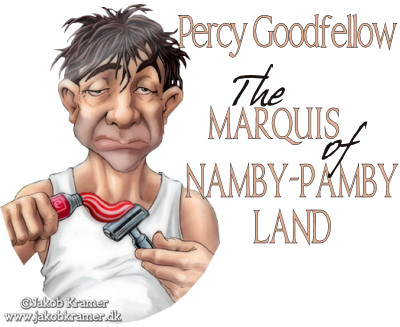 This blog is a doorway into the mind of Percy Goodfellow. Don't be shocked at the lost boys of Namby-Pamby Land and the women they cavort with. Watch as his caricatures blunder about the space between audacious hope and the wake-up calls of tomorrow. Behold their scrawl on the CRT, like graffitti on a subway wall. Examine it through your own lens...Step up my friends, and separate the pepper from the rat poop. Welcome to my abode...the armpit of yesterday, the blinking of an eye and a plank to the edge of Eternity. Note: This blog is my journal. I've no interest in persuading anyone to adopt my views. What I write is whatever happens to interest me when I start pounding the keys. |
| I like to pretend sometimes that I own a motorcycle shop and restore vintage motocross bikes from the 1970s. While I own quite a few, I am pretty much a failure as a mechanic. That doesn't dissuade me from pretending I'm like one of those Hot Shots that really understands motorcycles and makes those amazing U-Tube videos. Since I have been at this charade for some time I have surprisingly gotten better at my mechanical skills. However, I am still in a fog about how to wire up the Rectifier/Regulator I ordered on E-Bay. I hope there are instructions but won't be holding my breath. In the marketing diagram for this device it showed four wires with the following explanation. The diagram said, connect the hot wire to the battery positive terminal, the ground wire to ground, a third wire to the wire you want regulated and the forth wire somewhere else. It is really getting foggy in my brain. Maybe more later... don't hold your breath. |
| Before I started on the Bighorn adventure I knew that Electricity powered things I knew that Electricity was like a water tower. Voltage was like the pressure in the tank created by all that water high above the ground. I knew that pressure was created by the forces of gravity acting on the tower and that amperage was like the flow of water out from the tank powering the appliances in my home. Ohm's law was one of those three part power equations where if you know two of the values you can calculate the third. I knew all that and I could have probably passed a high school science test with flying colors. What I didn't really know was AC and DC current. If you remember your High School science one of the experiments was to wrap an iron coil with copper wire and then move a magnet over it and measure the current you induced. So what? You induced an AC electrical current. Big deal. That was my state of thinking about electricity until last week. It was scientific voodoo you couldn't see that made appliances work in today's world. In a motorcycle there is a crank shaft attached to a piston going up and down inside a cylinder. Attached to the crank case beneath this cylinder is a crank shaft and this shaft runs through an array of coils positioned around the shaft. This is called the Stator. Surrounding the stator is a flywheel with magnets inside. Voila, the piston is not just making the motorcycle go but is also producing electricity... AC Electricity. The number of loops around each of the coils determines how much current they produce. In my motorcycle there are three coils. One of these makes juice that goes goes up to the CDI box and powers the coil. The coil juices the current up and sends it to the spark plug. The spark plug ignites a vapor of compressed air and fuel and BANG... The big piston goes up and down, the crankshaft goes around and around and the mechanical forces proceed via a clutch and gear train, to a chain and rear wheel sprocket. Now that explains what the first coil is there for but what about the other two? Well, the second coil is there to tell the CDI box when to send the pulse to the coil. The first remember, created the current, the second coil tells it when to act. This depends on where the flywheel is in its rotation. You see just before the piston is in the perfect position to ignite the explosive mixture of air and fuel vapor, the second coil gives the signal and the big bang happens. It is worth noting at this juncture that we are discussing AC current. Keep in mind that when the north pole of the magnets in the flywheel pass over a coil the current is positively charged and when the negative pole passes the current becomes negatively charged. This is called AC or alternating current. As far as the spark plug cares either type is fine. As far as the signal coil cares either one is fine. And if there was a coil to run the light that would be fine too. AC current powers the lights in your house after all. The difference between a house an a motorcycle is that a house is stationary and served by a power plant and a motorcycle makes its own power on the fly. The problem with AC current is that a battery hates it. If your machine needs a battery a battery requires direct current and so the Third AC coil must convert the AC to DC or Direct current. It does this with a device known as a rectifier. This device rectifies the battery problem, at least to the extent of the current issue. There still remains a need to make sure the current stays within reasonable limits and doesn't destroy the battery or burn out the light bulbs. Keep in mind that early cars and motorcycles had a hand or foot crank to get the AC current flowing. This was fine as long as the operators were willing to turn the crank or kick the engine over. Once operators got addicted to electric starters, the need for a battery became self evident. So this required rectifiers and regulators. So now you know a bit more about AC and DC current and the need to understand why someone doing a rehab on a motorcycle needs a remedial knowledge of what is going on beneath the surface in order to get one running especially if it has been lying in a neglected state for the past half century. |
| F-5 350 Kawasaki Today I did a damage assessment on my 350 cc Kawasaki Bighorn. I took off the right side engine cover, and tested my rebuilt carburetor. To my astonishment I noticed a big glob of solder or maybe a weld behind where it mounted. The right side case is essentially junk. Maybe I can find a replacement on the Internet. Regardless I'll still try and get it running in this condition but wether or not the weld/solder fixed the problem is mute. There is no way that blob is going to fly. The carburetor still fits even though the attempted fix pinched the oil line. If run very long this would have done serious damage to the engine. Still the motor still turns over and that is a hopeful sign. This model of Bighorn has an external oil reservoir. The motorcycle does not required a premix of oil as the oil is designed to automatically flow down into the combustion chamber where it is metered by the throttle cable. I plan to take the oiling system out and seal it off and run a premix in the gas tank. While some say the oil also lubricates the main bearing others say that premixing works just fine. I probably need to pull the top end and take a look. I also noted that the tab where the rear break attaches was torn and will need welding. The steel foot lever has been cobbled together and will require some fabrication to work properly. Once I get the oiler taken out I can look to removing the part of the case that covers the clutch pack. The clutch is presently not working. I suspect it's corrosion and will sort itself out once it is cleaned. Then I can see if the transmission works. If it does I'll breath a huge sigh of relief, however sometimes the transmission works on the bench but under load reveals other issues. Broken gear teeth require spitting the case and a complete teardown of the engine. The good news so far is that I have a clean tank, a good carburetor, and an ignition that produces spark. If I can get the clutch to free up and the gears to work, I'm in a position to attempt cranking the engine to see if it still runs. At best this motorcycle will live on as a dirt bike and at worst will be used for parts. Time will tell. |
| I have twenty-five vintage 1970s motorcycles in my possession. Some run and some don't. Right now I'm focused on four. They are a Kawasaki Bison and three Kawasaki Bighorns. For the past month, sandwiched between all the other demands on my time I have been working to develop a more transparent understanding of how they operate and put into motion a rehabilitation project for the four. I use the term "Rehabilitation" rather than "Restoration" for a purpose. A restoration I define as returning the bike to its former showroom quality. This is a "Concours" motorcycle that is authentic down to the last detail. A rehabilitation gives the owner/operation more latitude. By latitude I mean being able to upgrade to more modern components as well as make design improvements that make the bike look "better." As one can imagine the two types of bringing a vintage motorcycle back from the grave require different mindsets and while advocates debate one method over the other, the end product is a machine, often a half century old, emerging as an awesome expression of creative effort. If you could see the four bikes today you'd wonder why bother? That is a question I often ask myself. The answer is that as a younger man, in my twenties I rode these bikes and spend many enjoyable hours on the road and in the dirt. Now that I am in my mid seventies, I have the time and resources to take on a rehabilitation project. Back in the 1970s I knew only the barest of how to maintain a bike and spent my time riding them. Now, in order to enjoy these machines once more, I have to take these surviving dual purpose bikes, ridden hard and put away wet, and left to languish for long periods of neglect and exposure to the elements. I'd been looking for a Bighorn and finally in 2019 had the chance to acquire the four bikes. The first of these was an F8 Bison, a 250cc which was a smaller variation of the 350 cc Bighorn I was looking for. It came in a three bike deal along with another 250cc Kawasaki and a Honda. They had all been abused and left to languish in a shed. The bike I had my eye on was the Bison. The data plate read F-8 10/71 #12249. It was red and had been molested, but all the pieces seemed to come with it and it turned over when it was kickstarted. Since I had not been able to find a Bighorn at a reasonable price, these three seemed a deal worth considering. I bought the lot for $700. Those three bikes remain today in the condition I found them. The reason I didn't turn the Bison into a project was three other bikes were to come my way in 2020 and as fortune would have it, they were all Kawasaki 350 cc Bighorns. The first of these was F-5 2/70 92733. It was brown, just like the one I purchased for $1000 when I came back from my first tour in Vietnam. It was a handful for me, weighting about 150 pounds at the time (me not the bike). It wasn't my first purchase of a dual purpose bike but it provided many fond memories. This motorcycle came from a small town in Northern Wisconsin. After talking with the owner over the phone we tentatively agreed on a purchase price. This price was one of those... If it lives up to the picture sort of agreements. Obviously if I was willing to drive six hours up and back I was interested and I told the guy to call me if he changed his mind. I really hate it when I drive a long way only to discover the seller has changed their mind. Anyway I arrived at this little town and the owner was an old motocrosser out in his shed working on his latest ride. He dug the bike out of a dusty corner and pushed it into the light of day. The first thing I noticed was the left hand side cover had been removed. Looking beneath the bell crank that the stator coils were missing. He handed me the backplate to which they had been once attached, gave the polish salute and said how sorry he was but that was the way he got the bike over thirty years ago. The agreed to price of $1000 dropped to $900 and firmed up when I kicked it over and realized there was good compression. This would not be the last time I'd find ignition issues with a Kawasaki Bighorn. Several weeks later I found another bighorn down in Rockford Illinois. It was a green F-5 2/71 07614. It was in the corner of the shop at a Maw and Pa dealership currently being run by the Son. There were two bikes sitting side by side. One was for sale and this became the best of the three I'd ultimately acquire. When I asked if it was "Running" he assured me it did and rolled his eyes when I asked him to fire it up. He did, and in fairly short order, and the shop filled with belching smoke. Slowly the motor began to clear and he drove it up and down the access road in front of his shop. It didn't run all that well but it was still fairly lively. The next week, another Bighorn popped up. It was in Fargo, North Dakota. It was an up in the morning early, drive all day, overnight and come home the next day. I knew in advance pretty much what to expect. It too was a green F5, 12/70 and the motor was seized. When I took the crank cover off it was filled with brown mud like it had drowned out in a stream and never started again. The deal went smoothly and I returned home with a third Bighorn. Regarding the latest acquisition I have yet to discover if the seizure is the result of corrosion and neglect or a mechanical issue. The good news was that the ignition coils are still in it, waiting to be tested. So this is as far as I intend to go tonight. I'm thinking about writing a book on my experiences. I'll be taking some pictures and using this blog to document the adventure. |
 View Portfolio
 Visit Notebook
 Send Gift Points
 Awards
 Badges
 Send Email


 Community Newsfeed
 Puzzle Hub
 General Discussion
 Sponsored Items
 Book of Trinkets
 Static Items
 Books
Books Groups
 Interactive Stories
 Audio
Audio Campfire Creatives
 Community Notes
 Crossword Puzzles
 Documents
 Folders
 Images
 In & Outs
 Madlibs
 Photo Albums
 Polls
Polls Product Reviews
 Quizzes
 Survey Forms
 Web Pages
 Word Searches


 Love it! Especially the safety measures for us homo sapiens...


