%%USERNAME%%    %%ACCWORDS%% %%ONOFF%% |

 Items to fit into your overhead compartment |
|
Carrion Luggage 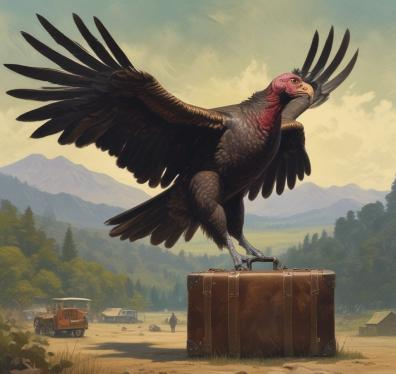 Native to the Americas, the turkey vulture (Cathartes aura) travels widely in search of sustenance. While usually foraging alone, it relies on other individuals of its species for companionship and mutual protection. Sometimes misunderstood, sometimes feared, sometimes shunned, it nevertheless performs an important role in the ecosystem. This scavenger bird is a marvel of efficiency. Rather than expend energy flapping its wings, it instead locates uplifting columns of air, and spirals within them in order to glide to greater heights. This behavior has been mistaken for opportunism, interpreted as if it is circling doomed terrestrial animals destined to be its next meal. In truth, the vulture takes advantage of these thermals to gain the altitude needed glide longer distances, flying not out of necessity, but for the joy of it. It also avoids the exertion necessary to capture live prey, preferring instead to feast upon that which is already dead. In this behavior, it resembles many humans. It is not what most of us would consider to be a pretty bird. While its habits are often off-putting, or even disgusting, to members of more fastidious species, the turkey vulture helps to keep the environment from being clogged with detritus. Hence its Latin binomial, which translates to English as "golden purifier." I rarely know where the winds will take me next, or what I might find there. The journey is the destination. |
|
Unlike yesterday's entry, I know exactly why I saved this one from Mental Floss: because words are fun. 15 Words Derived From Mythological Creatures—From “Money” to “Cereal”  Characters of ancient Greek and Roman mythologies have worked their way into modern vocabularies. I'm also going to brag that I knew almost every one of these. You can believe me or not; doesn't change anything. As the first month of the year, January somewhat appropriately takes its name from the Roman god Janus, who was associated with entrances, doorways, gates, and beginnings. Knew that one, too, though January wasn't always the first month of the year. 15 more words we owe to the Greeks and Romans are explored here. And I'm not covering all 15. Aurora was the Roman goddess of the dawn... As the early-morning bringer of daily light, Aurora’s name later came to be attached to the famous dawn-like phenomenon of swirling colored arches of light that appear in the night sky at high and low latitudes. Okay, well, auroras aren't very dawn-like, from what little I've seen. And I've been trying to see; there have been reports of auroras being seen all through the continental US due to a recent solar storm but, as usual, I saw nothing. Hyacinth is said to have been a beautiful young man who was struck on the head and killed while the god Apollo taught him how to throw a discus. At least he didn't teach him how to throw a disco. This, by the way, was the one I hadn't been aware of. Both money and the coin-producing mint where it is made take their names from Juno Moneta, an epithet for the Roman goddess Juno specifically associated with an ancient temple erected in her honor on Rome’s Capitoline Hill. What the linked article doesn't say, and is only mentioned in passing at the link given there, is that the actual translation of "Moneta" is "warner," as in "she who warns." I find this, in connection to money, amusing. Derived ultimately from a Greek word meaning a distribution or doling out of something, Nemesis was the name of a Greek (and later Roman) goddess of retribution and divine vengeance, who was tasked with either punishing or rewarding people for their evil or benevolent actions. And yet the "rewarding" part gets neglected. There are, of course, more at the link, for those who enjoy etymology. Just, as usual with MF, don't take anything too seriously unless you've double-checked the facts. |
 View Portfolio
 Visit Notebook
 Send Gift Points
 Awards
 Badges
 Send Email


 Community Newsfeed
 Puzzle Hub
 General Discussion
 Sponsored Items
 Book of Trinkets
 Static Items
 Books
Books Groups
 Interactive Stories
 Audio
Audio Campfire Creatives
 Community Notes
 Crossword Puzzles
 Documents
 Folders
 Images
 In & Outs
 Madlibs
 Photo Albums
 Polls
Polls Product Reviews
 Quizzes
 Survey Forms
 Web Pages
 Word Searches


