%%USERNAME%%    %%ACCWORDS%% %%ONOFF%% |

 Items to fit into your overhead compartment |
|
Carrion Luggage 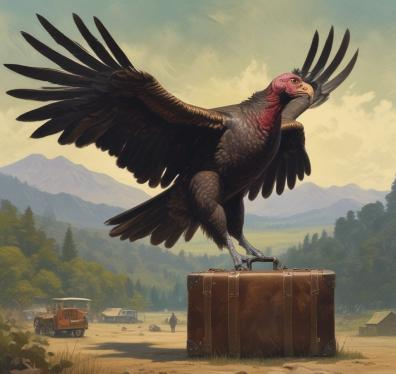 Native to the Americas, the turkey vulture (Cathartes aura) travels widely in search of sustenance. While usually foraging alone, it relies on other individuals of its species for companionship and mutual protection. Sometimes misunderstood, sometimes feared, sometimes shunned, it nevertheless performs an important role in the ecosystem. This scavenger bird is a marvel of efficiency. Rather than expend energy flapping its wings, it instead locates uplifting columns of air, and spirals within them in order to glide to greater heights. This behavior has been mistaken for opportunism, interpreted as if it is circling doomed terrestrial animals destined to be its next meal. In truth, the vulture takes advantage of these thermals to gain the altitude needed glide longer distances, flying not out of necessity, but for the joy of it. It also avoids the exertion necessary to capture live prey, preferring instead to feast upon that which is already dead. In this behavior, it resembles many humans. It is not what most of us would consider to be a pretty bird. While its habits are often off-putting, or even disgusting, to members of more fastidious species, the turkey vulture helps to keep the environment from being clogged with detritus. Hence its Latin binomial, which translates to English as "golden purifier." I rarely know where the winds will take me next, or what I might find there. The journey is the destination. |
|
Breaking one of my until-now unspoken rules here, I'm going to link to HuffPo today. As a reminder, I browse using ad and script blockers, so hopefully you'll be able to see the content through whatever popups they push at you. What 'Only Children' Bring Up The Most In Therapy  From feeling misunderstood to putting unnecessary pressure on themselves, here's what the only child may need help with. I'm shattering my rule because, as a former "only child," I was interested in what they had to say. Of course, it's been over 40 years since I could be considered a "child," but it's not like I suddenly grew siblings as I got older. Okay, that's not entirely true. There are people who I consider brothers and sisters, though I can't be sure if it's the same kind of relationship because all I have to go by are other peoples' stories. And judging by some of those stories, I didn't miss out on anything good. Some, but definitely not all. If you grew up as an only child, you’ve likely heard some of these stereotypical phrases at some point in your life: “That’s sad you grew up all alone.” “Your parents must’ve spoiled you.” “Do you have a hard time making friends?” And yet, they never ask people who had siblings things like "Was it hard, not being the center of attention?" Or, "How did it feel to feud with your siblings over the inheritance?" To address the quoted questions from my point of view: Not sad at all, it prepared me for a life of something close to self-sufficiency; yeah, they kind of did, but so what; and no, what I have a hard time with is meeting people. Yet recent research shows that many of these portrayals of only children are inaccurate. Color me shocked. Even though growing up without siblings is becoming more common, there’s still a long-lasting stigma around only children. And? At least when I was a kid, there was an even bigger stigma around childless people (the concept of "childfree" wasn't a thing yet). My parents could adopt exactly one brat, and that was, to my great good fortune, Me. We talked to therapists about the most common issues they hear only children bring up. What's not immediately clear is that this is mostly about what they bring up when they're older. You're always someone's child, but you're not always a "child." English is weird. In therapy, adult only children sometimes share that they feel lonely because they come from a smaller family and don’t have any sibling relationships. Not meaning to minimize others' experiences, but one thing I don't remember ever feeling was "lonely," either as a child or as a (technical) adult. There was always someone around to interact with. But I am moved to ask, perhaps rhetorically: "What about people with siblings who feel lonely?" In my view, it's better to never have had siblings at all than it is to be in a shitty relationship with the ones you have. “Holidays can be especially lonely for some only children because they often don’t have the big family gatherings that you see in movies and on TV.” Yeah... those movie and TV gatherings are generally idealized (or, possibly, whatever the opposite of "idealized" is when it shows a dysfunctional family). I've been to big family gatherings—both my ex-wives came from more traditional families, though one was also adopted—and while it was never exactly an unpleasant experience, I personally prefer to stay home by myself and relax rather than putting my best face on. As adults, many only children will seek out close friendships that feel like family members to fill that void, Clark said. See, this kind of wording is something I bristle at. It implicitly makes having siblings the "norm" while keeping one-child families as the "weird." Yes, as the article notes, they're a minority. But so are lots of other minorities—gay people, for example—and very few professionals these days would say something like, "many gay people will seek out close friendships with another gender to fill that void." At least not without getting pushback from both gay and straight folks. It's natural to seek out close friendships. Even I do it. It's not an exclusively "only child" thing. “Many adult only children feel overwhelmed and stressed being the only person in their family to handle all the elder care responsibilities for their elderly parents,” Greene said. Well, I had parents and a childfree aunt to deal with. And, to be honest, I couldn't. My parents both developed dementia, and that was way beyond what I was able to handle, so yeah, I hired professionals for that. It wasn't like I could quit my job to care for them full-time. Can I just point out, though, how weird it is that we put all the burden of elder care on the kids? That sort of thing may have made sense in a pre-industrial society, but now, it's just weird. Though having lots of attention from parents can lead to closer relationships with them, some only children may also feel like their every move is being watched. Well, that just prepares them for the reality of a surveillance state. Oh, and again, that's not limited to onlies. “Growing up as an only child can create a large sense of independence, which can be both a strength and a weakness,” said Priya Tahim... While I admit that it can be a weakness, I see it as a strength, at least in myself. I've never been reluctant to ask for help when I truly needed it. Speaking of which, anyone want to come over on Monday and shovel sn*w, so I don't get another heart attack? I'll pay. They may feel misunderstood or judged for being an only child. Okay, sure. But partly, that's because of articles like this one. Further perpetuating these stereotypes, only children are often portrayed negatively in movies and TV shows, such as being spoiled, selfish and having poor social skills, Greene added. I remember doing an article on a similar subject, recently, focused on adopted children. As I was both, my representation in media is fucked. At least until I remember Clark Kent. If you’d like to connect with and seek support from other adults who grew up without siblings, Greene recommends joining support groups on Facebook for only children. No. Therapy can also be an effective place to explore how your childhood is shaping who you are — no matter what your birth order is. I'm not going to rag on therapy in general. I've done it, with mixed results. But here's the problem: one of the things I'd like to talk about in therapy is my lack of motivation to do just about anything. To do that, I'd have to find a therapist. To find a therapist, I'd have to do work. And I don't have the motivation to do work, so I don't go looking for shrinks. Is that a vicious cycle, or a catch-22? I tried reading that book once and got bored very quickly. “Whether you are an only child, [oldest child], middle child or [youngest] child, there are pros and cons to each,” Tahim said. “It’s how we choose to grow, learn and adapt … that truly matters.” While I could quibble about "choose," I'm reminded of one of my favorite quotes of all time, from cartoonist R.K. Milholland: In the end, we decide if we're remembered for what happened to us or for what we did with it. |
 View Portfolio
 Visit Notebook
 Send Gift Points
 Awards
 Badges
 Send Email


 Community Newsfeed
 Puzzle Hub
 General Discussion
 Sponsored Items
 Book of Trinkets
 Static Items
 Books
Books Groups
 Interactive Stories
 Audio
Audio Campfire Creatives
 Community Notes
 Crossword Puzzles
 Documents
 Folders
 Images
 In & Outs
 Madlibs
 Photo Albums
 Polls
Polls Product Reviews
 Quizzes
 Survey Forms
 Web Pages
 Word Searches


