%%USERNAME%%    %%ACCWORDS%% %%ONOFF%% |

 Items to fit into your overhead compartment |
|
Carrion Luggage 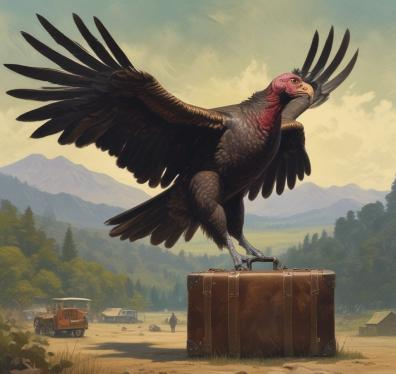 Native to the Americas, the turkey vulture (Cathartes aura) travels widely in search of sustenance. While usually foraging alone, it relies on other individuals of its species for companionship and mutual protection. Sometimes misunderstood, sometimes feared, sometimes shunned, it nevertheless performs an important role in the ecosystem. This scavenger bird is a marvel of efficiency. Rather than expend energy flapping its wings, it instead locates uplifting columns of air, and spirals within them in order to glide to greater heights. This behavior has been mistaken for opportunism, interpreted as if it is circling doomed terrestrial animals destined to be its next meal. In truth, the vulture takes advantage of these thermals to gain the altitude needed glide longer distances, flying not out of necessity, but for the joy of it. It also avoids the exertion necessary to capture live prey, preferring instead to feast upon that which is already dead. In this behavior, it resembles many humans. It is not what most of us would consider to be a pretty bird. While its habits are often off-putting, or even disgusting, to members of more fastidious species, the turkey vulture helps to keep the environment from being clogged with detritus. Hence its Latin binomial, which translates to English as "golden purifier." I rarely know where the winds will take me next, or what I might find there. The journey is the destination. |
| Yes, it's another Mental Floss listicle today. At least it's about writing, sort of. 15 Phrases True Grammar Nerds Would Never Confuse  Is it bald faced lie, or bold faced lie? Coming down the pike? Or pipe? Coleslaw, or cold slaw? Some people, I've found, mispronounce things. My ex, for example, pronounced "picturesque" as "picture-skew," and I thought it was so cute that I never said anything. To this day, over a quarter-century later, I have no idea if she was doing it on purpose or not, the way I pronounce "homeowner" as "ho-meow-ner." I never rag on anyone for this, though. It means they read, but they just interpreted the word as being pronounced differently. Same thing happened to me when I first read about quinoa. I pronounced it like "Genoa," and got laughed at. Bastards. It's not like we're born knowing these things. What I do admit to sometimes looking down my nose upon, though, is the reverse: people who hear things and then proceed to write them down wrong. A common example is when someone writes something like, "John was unphased." It's supposed to be "unfazed." Read more books. An eggcorn is a mistaken word or phrase that makes almost as much sense as the correct version. The term eggcorn was coined by linguist Geoff Pullum in 2003 as a nod to people’s habit of mistaking the word acorn for eggcorn. And yet, no one uses words that I coined, except me. In fairness, I'm not a linguistics professor. Feasible arguments are a big element of eggcorns: There’s no overlord deciding which language errors are logical enough to be official eggcorns and which ones are just plain mistakes. I know a few people who, given the chance, would absolutely sign up to be that overlord, the Chief of the Language Police. Hell, I'm one of them. Which is not to say I never make mistakes, of course. I'm not going to note all of them here. For All Intents and Purposes vs. For All Intensive Purposes The former phrase is the correct one, as the article explains. But that's a phrase I like to have fun with, too, pronouncing or spelling it as "For all intensive porpoises." Coleslaw vs. Cold Slaw Absolutely did this one when I was a kid. But when kids do it, it's kind of cute. Well, except me. I was never "cute." On Tenterhooks vs. On Tenderhooks "On tenterhooks" was one of my dad's favorite phrases. As in, "You're finally home. Your mom was on tenterhooks." (Actually, she was cool with it. My dad was the one who was worried about what Teen Me was getting up to at 2am, most likely for liability reasons.) Happy as a Clam vs. Happy as a Clown Honestly, I can absolutely see this one. As the article notes, the correct version (the first one) requires some knowledge of context, because, apart from that phrase itself, no one has ever considered a clam to be happy; contrariwise, clowns often have the smiles painted right on their faces. Deep-Seated vs. Deep-Seeded Also, this one. Having done more than my share of planting as a kid (before I started coming home at 2am), either can work, which I guess is the point of an eggcorn. Hair’s Breadth vs. Hare’s Breath Not so much this one. As thin as a hair might be, it still has some physicality to it, unlike "breath," which, like "wind," describes something usually unseen. Make Ends Meet vs. Make Ends Meat And the "meet/meat" homonym strikes again. Personally, I find the wrong one ("meat") to be hilarious. Again, more at the link. Just remember: these phrases are pretty much all clichés, so we shouldn't be using them much anyway. They still have a place in written dialogue, though, so it pays to get them right, or at least get them wrong on porpoise. |
 View Portfolio
 Visit Notebook
 Send Gift Points
 Awards
 Badges
 Send Email


 Community Newsfeed
 Puzzle Hub
 General Discussion
 Sponsored Items
 Book of Trinkets
 Static Items
 Books
Books Groups
 Interactive Stories
 Audio
Audio Campfire Creatives
 Community Notes
 Crossword Puzzles
 Documents
 Folders
 Images
 In & Outs
 Madlibs
 Photo Albums
 Polls
Polls Product Reviews
 Quizzes
 Survey Forms
 Web Pages
 Word Searches


