%%USERNAME%%    %%ACCWORDS%% %%ONOFF%% |




 Items to fit into your overhead compartment |
|
Carrion Luggage 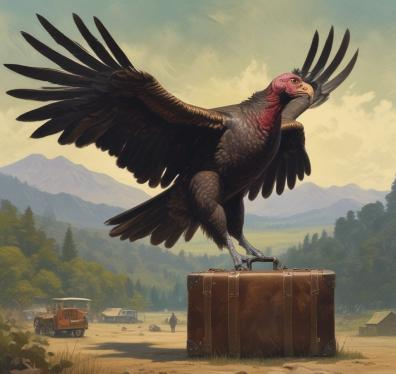 Native to the Americas, the turkey vulture (Cathartes aura) travels widely in search of sustenance. While usually foraging alone, it relies on other individuals of its species for companionship and mutual protection. Sometimes misunderstood, sometimes feared, sometimes shunned, it nevertheless performs an important role in the ecosystem. This scavenger bird is a marvel of efficiency. Rather than expend energy flapping its wings, it instead locates uplifting columns of air, and spirals within them in order to glide to greater heights. This behavior has been mistaken for opportunism, interpreted as if it is circling doomed terrestrial animals destined to be its next meal. In truth, the vulture takes advantage of these thermals to gain the altitude needed glide longer distances, flying not out of necessity, but for the joy of it. It also avoids the exertion necessary to capture live prey, preferring instead to feast upon that which is already dead. In this behavior, it resembles many humans. It is not what most of us would consider to be a pretty bird. While its habits are often off-putting, or even disgusting, to members of more fastidious species, the turkey vulture helps to keep the environment from being clogged with detritus. Hence its Latin binomial, which translates to English as "golden purifier." I rarely know where the winds will take me next, or what I might find there. The journey is the destination. |
| The absolute last thing I should be doing is talking about human interrelations. I know more about quantum physics, and I know almost nothing about quantum physics. But, in another example of random number clumping, here's another BBC article, this one on relationships: For once, a headline question can be answered "yes." Because a question like that, all you have to have is one counterexample. And I have friends who are exes, so there you go. Story over. ...except, of course, we already know that I'm an exception, an outlier, a better person. I suspect many people would say "hell, no." Break-ups are tough - you suddenly lose the person you shared everything with. But staying friends with an ex can be equally as painful. Well, yeah, but presumably you liked them for a reason, right? A reason that might be common grounds for friendship? Unless it was purely physical attraction, which there's nothing wrong with. I should note, however, that part of the "I don't know what I'm talking about" thing is that I'm not sure whether the article is talking about, like, just being cordial with the ex, or occasionally doing stuff together in a group, or somone you can call to help you move, or a full-on "help you move bodies" close friendship. That last one, admittedly, could get a bit awkward, I would imagine. It's like "Sure, I'll be there if you need me; I just find you unsuitable to live or mash genitals together with." "I don't have many friends who are friends with their exes, actually," says Olivia Petter, author of dating handbook Millennial Love. But she has managed it in a couple of cases. Obviously, this kind of thing is way behind me, anyway. So my interest is mostly sociological. Okay. I can't pass up noting yet another aptronym there. Almost makes me think "Olivia Petter" might be a nom de plume. But no one would be that obvious... would they? 1. How serious was it? "There are one or two men I've had brief, casual romantic relationships with that have evolved into friendships," Olivia told BBC Radio 4's Woman's Hour... But when it comes to serious relationships, she says while she's on good terms with them they're not close friends. See, that's the sort of thing I'm talking about. I run into my first ex-wife occasionally. We talk and catch up. Then we forget about each other again. Meanwhile, a month-long fling I had back in the 90s is the kind of friend where we text fairly often. She's on the other coast, so I don't just run into her. We both did a Thanksgiving dinner last year, though, with a group of friends. No awkwardness involved. 2. Are you over them? One of the biggest obstacles is whether you are able to separate the romance from the person. "You need to have processed the break-up, not just moved on logistically, but emotionally," Kate says. Huh... that's perilously close to what I said above. Maybe I should write a book about relationships and have BBC promote it. 3. How much time has passed? Yeah, that actually makes sense. Get past the big emotions. And, obviously, some relationships end with unforgivable acts. 4. Is your new partner ok with it? If you do decide to stay friends, then Kate says you need to talk openly about what you are both going to do if the other gets into a new relationship. And if a new partner is uncomfortable with the friendship, Kate stresses you should take their concerns seriously. We didn't use the words "red flag" way back when I was dating, but one immediate "no" signal for me was when someone indicated that being friendly with an ex was a big "no" signal for her. Most of my friends are women. Some are exes. I wasn't about to give up long-term friendships because someone new doesn't trust it. You may need to have a conversation with your ex to adjust the friendship which could be "less frequent contact, more group settings, or being more transparent about what you're doing together," she says. And then, from my longer-term perspective, sometimes friendships just fade out, whether there was ever romance and/or doinking involved. People drift apart. It's just a fact of life. It's not always a, pardon me for adopting the term, "conscious decoupling" or whatever. (I'm applying this to friendships as much as romance.) I guess, for me anyway, I just feel like holding a grudge hurts you more than it does the other person, so I try not to do it. Doesn't mean we have to do stuff together, but it hurts me not at all to at least be cordial. Again, though, I have a longer perspective on these things. It's different for younger people, and society is different, too. Hence my interest in the subject remaining purely scientific. |
 un:
un:  View Portfolio
 Visit Notebook
 Send Gift Points
 Awards
 Badges


 Community Newsfeed
 Puzzle Hub
 General Discussion
 Sponsored Items
 Book of Trinkets
 Static Items
 Books
Books Groups
 Interactive Stories
 Audio
Audio Campfire Creatives
 Community Notes
 Crossword Puzzles
 Documents
 Folders
 Images
 In & Outs
 Madlibs
 Photo Albums
 Polls
Polls Product Reviews
 Quizzes
 Survey Forms
 Web Pages
 Word Searches


