%%USERNAME%%    %%ACCWORDS%% %%ONOFF%% |


 Items to fit into your overhead compartment |
|
Carrion Luggage 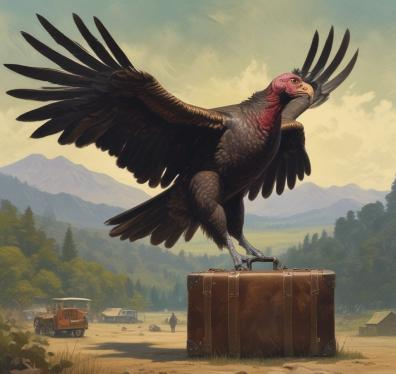 Native to the Americas, the turkey vulture (Cathartes aura) travels widely in search of sustenance. While usually foraging alone, it relies on other individuals of its species for companionship and mutual protection. Sometimes misunderstood, sometimes feared, sometimes shunned, it nevertheless performs an important role in the ecosystem. This scavenger bird is a marvel of efficiency. Rather than expend energy flapping its wings, it instead locates uplifting columns of air, and spirals within them in order to glide to greater heights. This behavior has been mistaken for opportunism, interpreted as if it is circling doomed terrestrial animals destined to be its next meal. In truth, the vulture takes advantage of these thermals to gain the altitude needed glide longer distances, flying not out of necessity, but for the joy of it. It also avoids the exertion necessary to capture live prey, preferring instead to feast upon that which is already dead. In this behavior, it resembles many humans. It is not what most of us would consider to be a pretty bird. While its habits are often off-putting, or even disgusting, to members of more fastidious species, the turkey vulture helps to keep the environment from being clogged with detritus. Hence its Latin binomial, which translates to English as "golden purifier." I rarely know where the winds will take me next, or what I might find there. The journey is the destination. |
|
Last year, I did an entry about the Rubin telescope: "Hey Rubin" Today, a followup, this one featuring an article from space.com: The Rubin Observatory will change the game for astronomy — if satellite companies don't get in the way "Every night — every minute — is precious." In June of 2025, we were greeted with a set of space images so special that one scientist even deemed them worthy of the title "astro-cinematography." Indeed, they were unbelievable, dotted with TV-static-like dots representing millions of galaxies, printed with nebulas resembling watercolor canvases, and bursting with data about some of the farthest cliffs in our observable universe. "Unbelievable" is here being used figuratively. The cool thing about it is that it's totally believable—if astounding, amazing, superlative, etc. Rubin has the ability to thoroughly image the night sky over and over again from its vantage point atop Cerro Pachón in Chile, and with unprecedented efficiency at that. It's only natural to wonder why, if we can do such great astronomy here on Earth, we need to also spend billions on space telescopes. I'm not an expert, but space-based observatories still have major advantages, including being able to see in wavelengths that even our thinnest atmosphere blocks. "We're going to actually create more data than all optical astronomy has ever had in the first year of our decade of operations, which absolutely blows my mind," Meredith Rawls, an astronomer working on the observatory, said during January's American Astronomical Society meeting. If true, and I'm not doubting it, that really is unbe- er, I mean, astounding. An Earth-based telescope approaching the limits of modern technological power is unfortunately forced to contend with another kind of scientific advancement happening in space: the exponential rise of satellites in Earth orbit. I'm not the only one who sees the irony here, right? We finally have the technology to make ground-based optical astronomy better, but that same level of technology allows us to loft satellites into orbit fairly cheaply, thus detracting from the awesomeness of the astronomy. As of writing this article, there are about 14,000 satellites orbiting our planet — nearly 10,000 of which belong to SpaceX — and the number is going to increase aggressively as commercial interests in this realm continue to grow. Some years back, I spent a week in the way too high and cold mountains in Colorado with a bunch of other astronomy nerds. Even with our commercially available telescopes, we couldn't observe a single star or planet without seeing at least one flash of a satellite cross the field of view. SpaceX has actually recently floated the idea of a data center in our planet's orbit, which would involve putting something like a million more satellites up there. Heh. "Floated." I see what you did there. Seriously, though, Space-sex's head honcho has floated a lot of ideas, the vast majority of which suck, and most of which never come to fruition anyway. Priceless Rubin images could therefore be tainted by commercial satellite interference, or "streaks," as astronomers say. Which, I suppose, brings us back to needing to loft more space-based telescopes, which adds to the number of human artifacts in space. Just this month, physicians and scientists from Northwestern University announced they're worried about satellites in Earth orbit disrupting our sleep patterns. I went to the link to that, because it seemed farfetched to me, but it seems like it's a warning against further light pollution from orbit, not saying that it's already causing sleep problems. "They change the night sky," Rawls said. "Turns out, telescopes are not the only things that look up." "We are all in the gutter, but some of us are looking at the stars." -Oscar Wilde |
 un:
un:  View Portfolio
 Visit Notebook
 Send Gift Points
 Awards
 Badges



 Community Feed
 Puzzle Hub
 General Discussion
 Sponsored Items
 Book of Trinkets
 Static Items
 Books
Books Groups
 Interactive Stories
 Audio
Audio Campfire Creatives
 Community Notes
 Crossword Puzzles
 Documents
 Folders
 Images
 In & Outs
 Madlibs
 Photo Albums
 Polls
Polls Product Reviews
 Quizzes
 Survey Forms
 Web Pages
 Word Searches


