%%USERNAME%%    %%ACCWORDS%% %%ONOFF%% |


 Items to fit into your overhead compartment |
|
Carrion Luggage 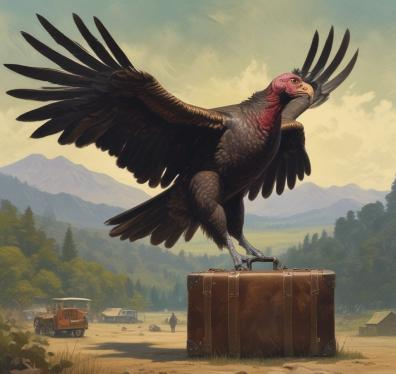 Native to the Americas, the turkey vulture (Cathartes aura) travels widely in search of sustenance. While usually foraging alone, it relies on other individuals of its species for companionship and mutual protection. Sometimes misunderstood, sometimes feared, sometimes shunned, it nevertheless performs an important role in the ecosystem. This scavenger bird is a marvel of efficiency. Rather than expend energy flapping its wings, it instead locates uplifting columns of air, and spirals within them in order to glide to greater heights. This behavior has been mistaken for opportunism, interpreted as if it is circling doomed terrestrial animals destined to be its next meal. In truth, the vulture takes advantage of these thermals to gain the altitude needed glide longer distances, flying not out of necessity, but for the joy of it. It also avoids the exertion necessary to capture live prey, preferring instead to feast upon that which is already dead. In this behavior, it resembles many humans. It is not what most of us would consider to be a pretty bird. While its habits are often off-putting, or even disgusting, to members of more fastidious species, the turkey vulture helps to keep the environment from being clogged with detritus. Hence its Latin binomial, which translates to English as "golden purifier." I rarely know where the winds will take me next, or what I might find there. The journey is the destination. |
|
I held on to this article from The Independent for reasons anthropological, not because it has anything to do with me. Men told me why they really hate singles nights – and it was heartbreaking When Olivia Petter wrote a piece on why men aren’t signing up to singles nights, she couldn’t have anticipated the outpouring that came from the men who read it. And what they told her really resonated Yes, the headline's a bit clickbaity. Might need some translating, too: "singles night" seems to be what we in the US call "speed dating," which is kind of a get-to-know-you musical chairs game. Before we get into it, yes, regular readers have run into Olivia Petter before here: "Friend Zone" No, I'm not stalking her. Occasionally, you write something that strikes a nerve. A recent one of mine about men not attending singles nights was one of them. Since the piece was published – you can read it here if you missed it – I’ve received hordes of emails from men, eager to share their thoughts with me. Knowing how some men are, I don't think "thoughts" were the main thing they were eager to share. But the men writing to me this time weren’t like that. They were intentional, heartfelt, and honest. So, they were actually women, pretending to be men on the internet. Yes, I'm joking. We can be those things, or at least fake them. It's easier when you're anonymous. And they were interesting, too, offering up a wide range of insights into why men might be more reluctant going to a singles night than women. The important part here is, I think, the "wide range" bit. Men aren't all the same, despite what androphobes will tell you. One of the common themes was vulnerability, which my article touched on. “Men are used to being rejected; women are often the ones rejecting,” one person wrote. “Experiencing this again, but with an audience, can’t be that tempting.” Bit of a stereotype there, too. But there's probably a bit of truth to it. Yes, it’s a bruise to the ego if someone you’re attracted to doesn’t reciprocate your feelings. But it’s not like that happens on stage in front of a crowd that will jeer and throw tomatoes at you. Are you sure about that? There were a few helpful pointers, with some men saying that the alcohol element made it tricky for those who don’t drink, while others added that the noise of these events can be overwhelming – honestly, I agree, and I often lose my voice at my own singles nights. On the flip side, if there's no alcohol, I absolutely ain't going. And the noise thing sounds downright inhospitable. Some men argued that the psychology of modern dating favours women more than men, potentially because women can be more emotionally fluent, a skill that the men writing to me often revealed can make them feel inadequate and even more awkward. I think that’s a shame and a view that reinforces harmful stereotypes that will only divide us further in the long run. Gotta agree with the author here, even if she is a chick. That said, some people clearly enjoy gender roles and feel that singles nights harmfully undermine them. One man wrote that the format itself goes “against the grain of how many men are wired to court”. “Being lined up for inspection, filling in forms, rotating on a timer – not just uncomfortable, but actively undermines the qualities that tend to make men attractive in the first place: spontaneity, confidence, a bit of mystery. Hard to be mysterious when you’re wearing a name badge. It doesn’t feel particularly ‘blokey’ to offer yourself out for selection.” Counterpoint: I play video games and appreciate it when the other characters' names are floating above their heads. Lots of men suggested integrating activities into dating nights to give them a more competitive edge – “Add some sort of competition with built-in conversation starters. A quiz? Cooking? Cocktail-making competition? Why not a go-kart event?” – and one rather boldly advised archery, as he’d been to a singles event like this recently. And that would shut me right out entirely. It's already a competition. I despise competition. Why would I want to manufacture more of it? But I remain somewhat unconvinced that the way to help men meet women in person is to give them weapons. And this is why I bothered to save the article: there used to be a trope in comics where a primitive man would beat a primitive woman over the head and drag her back to his cave. Obviously, it's a good thing that this trope has died out (though I think an echo remains in the Star Trek universe, with Klingon culture), but that's absolutely what it reminded me of. One gentleman got in touch via email with an even more unconventional suggestion. “May I suggest you interview multiple Pokemon Go players and set up your girls’ dating trips on a weekend at a park with Pokemon Go being the focus?” he wrote. “You could bring cases of wine from Costco and have your membership still [valid] for your side gig dating programme, but trade dresses and high heels for comfortable walking shoes and sneakers.” I’m sure there’s a market for this somewhere, though I can’t say it’s something I’ve got planned in the pipeline. I'm a huge nerd. I know I'm a huge nerd. But listen, if your entire personality is Pokemon, then hang out with other Pokemoners, or whatever they're called. I'm not judging, mind you; I know it's very popular, but it's still going to leave out people who aren't into Pokemon. Overall, I’m flattered that so many men got in touch with such a range of responses. Evidently, many of us are feeling fatigued and confused by modern dating, particularly within the heterosexual demographic. And I'm just glad I'm out of that game for good. It seems wearying and degrading for everyone involved, not just some of the men. I'm also curious—again, just from an anthropology perspective—if there might be a cultural component to it, if it applies outside the UK as well. People are people everywhere, but there are different cultural norms and expectations for gender roles. Still, I can't help but think the problem is a symptom, not the disease. It seems to me, though I'm far from an expert, that such things as singles nights (or speed dating on this side of the pond) just encourages people to think of relationships as fungible, and to keep looking even after you've found a match, because you never know: There might be someone better just around the corner. Maybe that's a good thing, though. Maybe it helps people be better people, so they can keep up. Or, like me, you just give up entirely. |
| Last year, I did an entry about the Rubin telescope: "Hey Rubin" Today, a followup, this one featuring an article from space.com: The Rubin Observatory will change the game for astronomy — if satellite companies don't get in the way "Every night — every minute — is precious." In June of 2025, we were greeted with a set of space images so special that one scientist even deemed them worthy of the title "astro-cinematography." Indeed, they were unbelievable, dotted with TV-static-like dots representing millions of galaxies, printed with nebulas resembling watercolor canvases, and bursting with data about some of the farthest cliffs in our observable universe. "Unbelievable" is here being used figuratively. The cool thing about it is that it's totally believable—if astounding, amazing, superlative, etc. Rubin has the ability to thoroughly image the night sky over and over again from its vantage point atop Cerro Pachón in Chile, and with unprecedented efficiency at that. It's only natural to wonder why, if we can do such great astronomy here on Earth, we need to also spend billions on space telescopes. I'm not an expert, but space-based observatories still have major advantages, including being able to see in wavelengths that even our thinnest atmosphere blocks. "We're going to actually create more data than all optical astronomy has ever had in the first year of our decade of operations, which absolutely blows my mind," Meredith Rawls, an astronomer working on the observatory, said during January's American Astronomical Society meeting. If true, and I'm not doubting it, that really is unbe- er, I mean, astounding. An Earth-based telescope approaching the limits of modern technological power is unfortunately forced to contend with another kind of scientific advancement happening in space: the exponential rise of satellites in Earth orbit. I'm not the only one who sees the irony here, right? We finally have the technology to make ground-based optical astronomy better, but that same level of technology allows us to loft satellites into orbit fairly cheaply, thus detracting from the awesomeness of the astronomy. As of writing this article, there are about 14,000 satellites orbiting our planet — nearly 10,000 of which belong to SpaceX — and the number is going to increase aggressively as commercial interests in this realm continue to grow. Some years back, I spent a week in the way too high and cold mountains in Colorado with a bunch of other astronomy nerds. Even with our commercially available telescopes, we couldn't observe a single star or planet without seeing at least one flash of a satellite cross the field of view. SpaceX has actually recently floated the idea of a data center in our planet's orbit, which would involve putting something like a million more satellites up there. Heh. "Floated." I see what you did there. Seriously, though, Space-sex's head honcho has floated a lot of ideas, the vast majority of which suck, and most of which never come to fruition anyway. Priceless Rubin images could therefore be tainted by commercial satellite interference, or "streaks," as astronomers say. Which, I suppose, brings us back to needing to loft more space-based telescopes, which adds to the number of human artifacts in space. Just this month, physicians and scientists from Northwestern University announced they're worried about satellites in Earth orbit disrupting our sleep patterns. I went to the link to that, because it seemed farfetched to me, but it seems like it's a warning against further light pollution from orbit, not saying that it's already causing sleep problems. "They change the night sky," Rawls said. "Turns out, telescopes are not the only things that look up." "We are all in the gutter, but some of us are looking at the stars." -Oscar Wilde |
| Something else a little different today, from Inverse: 70 Years Ago, Forbidden Planet, Flaws and All, Changed Sci-Fi Forever Return to Forbidden Planet. If you dare. Full disclosure up front here: I've never actually seen the whole movie. So I'm not here to discuss the movie; I'm here to discuss the article, which discusses the movie. On March 3 and 4, 1956, at a humble science fiction convention in Charlotte, North Carolina, called SECon II (Southeastern Science Fiction Convention), roughly 30 people got an early screening of what one hardcore enthusiast, at the time, called “the first real s-f film, as fans know science fiction.” Yes, cons have been around for a while. So have huge nerds. And gatekeepers. By which I mean, calling it "the first real s-f film" is rather a matter of opinion. I think it's generally accepted that Le Voyage dans la Lune holds that honor, and that one was made before two brothers from Ohio paid a visit to North Carolina, when even airplanes were the stuff of science fiction. It could be argued, of course, that the Méliès film is more fantasy than science fiction, but sometimes the boundaries blur into insignificance. Consider Star Wars, for example, which is fantasy with SF tropes. He also noted that the people in the audience (again, very small, made of hardcore fans) were “sitting on the edge of their seats,” and “comments following the showing were enthusiastic.” It's easy to sit here in 2026 and scoff at the primitive films of the 20th century. But I believe in taking things in historical context. So, while I dispute the claim of "first real s-f film," I don't deny its impact within its own time period. Again, for context, this was the year before Sputnik turned another SF speculation into reality. Today, this might seem like an understatement, considering the degree to which Forbidden Planet changed pop culture, or at least pioneered a certain kind of mainstream space-oriented science fiction which would dominate mainstream TV and film sci-fi for decades to come. (For what it’s worth, they didn’t call it sci-fi back then, by the way, hence s-f.) I still refuse to call it "sci-fi." Yes, I know that's the official genre label here on WDC, but as a huge nerd and gatekeeper, I hate that particular shortcut. If you're going to shorten something, have the common decency to keep the vowel sounds intact. Forbidden Planet is a beautiful film, way ahead of its time visually and sonically, that now feels slow, poorly paced, and full of concepts that the 1960s Star Trek did much better, and with more joy. Yes, okay, but Star Trek wouldn't ever have existed without three major pillars: Roddenberry (obviously), Lucille Ball (yes, really), and Forbidden Planet. So, I feel like claiming it's a low-class version of Trek is disingenuous; it's an important part of Trek background. In short, in 2026, 70 years after its release, Forbidden Planet isn’t greater than the sum of its robot parts, but some of its parts are not only great, but now woven into the basic fabric of science fiction in general. And FP, in turn, built on SF concepts that preceded it. Mild spoilers ahead. For fuck's sake, the movie is 70 years old. Hey guys, spoiler alert: Rosebud was his sled! Hume’s rewrite of the movie injected a more intellectual angle, which, today, scans as almost a rough draft for the original Star Trek. Gene Roddenberry screened Forbidden Planet to his Star Trek collaborators in 1964 to get a sense for the vibe he was going for. "More intellectual" should not be parsed as "highbrow art." Not that I care about brows. Just managing expectations, here. Like Star Trek — at least early 1960s Star Trek — Forbidden Planet presents a story about a spacecraft crewed by people who behave in a roughly navalist way, assigned to check on the status of an older Earth spaceship, the Bellerophon, which was lost on the planet Altair IV years prior. (Both Star Trek pilot episodes in 1964 and 1954 find the crew searching for clues about a lost Earth mission, too.) So, fact check here: 1) There was no early 1960s Star Trek; the best one can say is that it began in 1964, which I'd call mid-sixties, when the first pilot episode (The Cage) was made, and even then, it wasn't ready until early '65. 2) "1954?" Gotta be a mistype. The second Trek pilot was in 1966, though it was the third episode aired: Where No Man Has Gone Before. You don't have to be a hardcore Trek fan to know that The Cage eventually got folded into the series, with a framing story involving Kirk and Spock, a two-parter called The Menagerie. Why does this detail matter? Well, at the time, having a science fiction movie that presented interstellar space travel as an established fact, rather than a gee-wiz new invention, was somewhat novel. And this is why context matters. I would be remiss if I didn't point out that in literature, such stories already existed, but SF had a really bad reputation (partially deserved) at the time, so the stories didn't reach a mass audience the way movies did. There are probably more words written about Robby the Robot — the most expensive movie prop ever built up until that time — than there are about any other aspect of Forbidden Planet. But what makes the movie worth watching, or, perhaps, worth studying, isn’t the robot. It’s the tone. The whole trope of the robot companion, brilliantly parodied by Douglas Adams and turned on its head by Battlestar: Galactica, may be the most lingering echo of FP. Consider the droids in Star Wars, the computer HAL9000 in 2001, the entirety of Lost in Space, the freakin' Jetsons, etc. Oddly, it was the one thing Trek never really dabbled in: there was The Computer, which probably wasn't sentient like HAL, and of course the character of Data in TNG, but he was presented as a fully sentient being, not a robot pal. In short, what makes Forbidden Planet less than brilliant today is threefold: The prevalence of sexism in its first act is extremely distracting, by both 1956 standards and today. The plotting is poorly paced, with everything great crammed into the last 15 minutes. And, finally, let’s face it, Star Trek did it better a decade later. Okay, well, I'm going to leave it to the article to make these cases. I'll present a different point of view here. Sexism: Look, pretty much every movie from the 1950s is cringeworthy on this front today. As I have not seen FP, I don't have a personal opinion about it. But having read a great deal of SF from that era, it doesn't sound out of line with what one expected from SF in the 1950s. There was no secret that the principal audience of SF at the time was young men, and the writers wrote what they thought young men at the time wanted, which included manly men who are also huge nerds blasting at space aliens and getting the girl in the end. I'm not saying it was right, mind you. Just that I have my doubts about it being distracting "by 1956 standards." One of the more brilliant things George Lucas ever did was making Luke and Leia (SPOILER ALERT) siblings, which neatly sidestepped that trope. And then leaned into it again with Han Solo, but that's beside my point. As for the plotting, again, I haven't seen it, but if what the article's author wrote is true, that is indeed a damning indictment. At least if you care about the writing. I'm assuming everyone here would, because, well. The third point there, the one about Trek, may also be true. But I think it's irrelevant, because, as I noted (and the article seems to agree), Trek wouldn't exist without FP. Where Forbidden Planet introduces these themes with Shakespeare-esque gravitas, Star Trek smartly always made those kinds of conflicts deeply personal as well as philosophical, especially in its first two pilot episodes. There is one other major difference: Star Trek has moments of real comedy. Comedy was even a plot point in the aired pilot. The scene where Scotty defeats a far superior alien by getting him completely and totally schloshed is one of the greatest TV show moments of all time, and that was in the pilot. Comedy is, in fact, baked into Trek's DNA. But that should come as no surprise, considering who finally greenlit the show. Thanks, Lucy. |
An unusual source for me, Self, brought to my attention by Elisa the Bunny Stik  : : 5 Signs You Have ‘Toxic Independence’ Healthy self-sufficiency is a choice. Toxic independence is survival. Up front, the "toxic" label bugs me, because I feel like it's starting to creep into everything. I suppose that's fair, as actual toxic substances are creeping into everything. You’re going through something big, but you don’t speak up. Speak up to whom, exactly? My cats? You’re exhausted, but you white-knuckle through the day. Nah, I give up and go take a nap. Your friends offer help, but you brush it off. My cats are always offering to help, especially with typing. I brush them off. Well, I gently pick them up and pet them and set them softly on the floor, but still. If this sounds familiar, you probably pride yourself for being self-sufficient and always tending to your own needs. I'm being a little unfair up there. I do have friends. Some of them are even human. Most are long-distance, though, and the ones who aren't don't need to hear me kvetching about every little thing. I did, however, have self-sufficiency beat into me as a kid. Sometimes literally. But when you make a conscious choice to remain an island—sometimes even choosing to sink rather than seeking out help—you’re practicing an extreme form of self-reliance known as toxic independence. So, that ain't me. I do seek help when I need to, even if I have to pay for it. (Before you make the joke, no, I don't hire sex workers.) While not an official classification in the Diagnostic and Statistical Manual of Mental Disorders (DSM),... That doesn't necessarily make it wrong, but if you're trying to get professional help for it, you might have a hard time finding a shrink who- wait, if you have it, you're not seeking help of any kind, so it's a moot point. ...the trait could still have some undesired effects on your mental and emotional well-being. Asking for help all the damn time does, too. As usual, the proper, approved state is somewhere in the middle. There’s a clear distinction between healthy self-sufficiency and toxic independence, says Yasmine Saad, PhD, a licensed clinical psychologist and the founder and CEO of Madison Park Psychological Services in New York City. Okay, but can I just take a moment to snicker at the name Saad for a psychologist? The former allows the freedom to balance taking care of yourself and relying on others—without any hang-ups if you choose to do so—while the latter involves valuing self-reliance at any cost and an aversion to seeking outside help. “Healthy self-sufficiency is a choice, [whereas] toxic independence is a survival strategy,” says Dr. Saad. I'm still not clear on the difference. Isn't "valuing self reliance at any cost" a choice? Sure, I can accept that it's influenced by genetic or environmental factors, but aren't all of what we consider "choices?" Toxic independence can also manifest later in life as “a reaction to a belief or a past hurt related to relationships,” Dr. Saad says. Perhaps you were cheated on; as a result, you might avoid relationships because being single feels safer. I do not like being personally attacked. Here are a few telltale signs that your independent streak veers into toxic territory. I'm sure we can collectively figure out a few more. 1. You never ask for help. If even the thought of asking for help makes you itch, toxic independence is likely at play. There are certain itches, like between one's shoulder blades, that are hard to deal with without help. This can be extended metaphorically. 2. You see dependence as weakness. Perhaps you look down upon people who ask lots of questions, rely heavily on their significant other, or have no problem asking for a favor. I distrust anything that someone calls "weakness." I keep hearing "Sleep is for the weak," which always boils my buttocks. 3. You feel isolated. As wonderful as independence is, toxic independence can have serious repercussions on your relationships and livelihood. “It erodes intimacy because deep connection is built through vulnerability, trust, and interdependence,” says Winkler. Or maybe you're isolated because you're an asshole. Not "you," the reader, of course. You are kind, intelligent, perspicacious, and attractive. But the generic "you." 4. You crave control and mistrust others. No matter whether you’re dealing with a group project or organizing a girls’ trip, you feel like you’re the only person who could possibly get the job done. I'm fairly certain that if I tried to organize a girls' trip, people would wonder what my motivations are, and I'd probably be questioned by the po-lice. 5. You feel the need to protect yourself at all costs. According to Dr. Saad, protection is at the core of toxic independence. This makes you operate from a place of fear of the worst-case scenario rather than having safety and trust in others. In fairness, expecting the worst-case scenario means you can rarely be disappointed. The article continues with some tips for people who fit that profile. But I expect the tips count as "help," so how many people who need to will heed it? In any case, my personal take is that, while I'm not going to dismiss the idea that someone can be too independent and self-sufficient, I always look at articles like this with some degree of skepticism. The basic format: "There might be something wrong with you. Do you fit this profile? Then here's something that will help!" is very similar to advertising techniques, and advertising gives me hives (metaphorically). But this time, it doesn't feel like they're selling a product. Yes, Dr. Saad's (still chuckling here) psych practice is noted, but the article's audience extends to the world, not just NYC (however much NYCers believe that they are the entire world, they are not). Perhaps it's a general promotion of psychology, which I also have mixed feelings about, and I'll try to articulate why: The practice of clinical psychology exists to try to "fix" people, in a sense. It's just good marketing, therefore, to convince people that they are broken and need to see a shrink. I'm not saying shrinks are worthless, mind you, though I do accept that results vary. It's just that when you see stuff like this, basically asking "Are you broken?" it pays to examine the article through the lens of: "Am I really broken or are you just promoting shrinkage?" In this case, I can see how what they're calling "toxic independence" can be a problem for some people. But you know how when you have a hangnail and you look it up online and they tell you if you don't get it treated immediately, you could die? It's like that. I guess what I'm advocating for, here, is to watch out for signs of that particular marketing technique, and ask what the motivation is for posting stuff. Maybe they're legitimately trying to help people. But maybe they're trying to sell a product or service. It's also possible to do both; not all products or services are wastes of money. I'm not sure if I'm explaining myself well, here, which is always frustrating for me as a writer. Maybe if I asked for help... |
| We haven't had one of these for a little while: a language-related listicle from Mental Floss. 8 Words That Are Only Used in One Weirdly Specific Context Think about it: have you ever heard someone say they had “extenuating errands”? Well, now next time someone invites me somewhere, I can say I have extenuating errands. The English language is certainly bizarre in the best way. For instance, there are values of "best" I wasn't aware of until just now. Some of it is totally run-of-the-mill, and some of it is full of words that only seem to appear in one extremely specific situation. There's another listicle somewhere that explains "run-of-the-mill." Maybe I already featured it. Maybe it's coming. Maybe I forgot to save it. I don't recall. It's really not hard to guess at, but I think it's good for writers to think about these things. So let’s take a little stroll through eight words that only show up in one weirdly specific context. Including the word "weird" in the headline (and to a lesser extent, here) is way too close to clickbait. But have you ever wondered why "weird" is so weird? I mean, it doesn't even follow the well-known "I before E except after C" spelling rule. Anyway, I'm not going to cover all of them. Inclement (Weather) If you’ve ever heard the word “inclement” outside of local news broadcasts, please step forward, because we know you’re lying. This is, of course, our clue to use it to describe something other than weather. The situation at the office, maybe, or a police raid. What the article doesn't note, but I will, is that this is one of those Latin-root words whose cousins appear every now and then. The obvious example is the name "Clementine," or the citrus fruit that has that name. But my dictionary source says "clement" can describe someone's demeanor (synonym: merciful), so why can't "inclement?" Diametrically (Opposed) Diametrically has one job: heighten drama. No one is ever diametrically aligned, and no one is diametrically friends. That's because the meaning is something like "directly and completely," and it doesn't hurt that the word contains many of the same sounds. This isn't a case like "literally," which is often used to mean "figuratively or metaphorically" and also to heighten drama. "Figuratively" and "metaphorically" have definitions that should be diametrically opposed to that of "literally." Bode (Well/Ill) Bode is a free agent in theory, but let’s be honest: you’ve only ever seen it next to “well” or “ill.” Again, an opportunity to get this one to stretch a bit. Hermetically (Sealed) Now, this word is a little “underground,” if you will. Hermetically sealed sounds like something out of a sci-fi lab, but it mostly refers to food packaging and those little foil seals you peel off with your teeth, even though you’re not supposed to. This one's a little trickier. It doesn't mean what I thought it meant for most of my life. I thought it was related to mercury (the element, not the planet or the god), by extension from Mercury to Hermes. I thought it had to do with how liquid mercury could form seals. In my defense, I wasn't too far off, but it referred to an entirely different god: Thoth, the Egyptian god of knowledge who, when the Greeks took over Egypt, became identified with Hermes. How that led to things being described as hermetically sealed is interesting, but beyond today's scope. If that's a little confusing, don't worry. I was confused, too. The link in the article only goes to something that explains what "hermetically sealed" does, without going into the word origin. Pyrrhic (Victory) Of all the words here, I think this one makes the most sense to be paired with only one other word. Again, it's of ancient origin, but it's derived from a person's name: a Roman general named Pyrrhus. And to one particular battle, which his forces won, but only at great cost. It became the Platonic ideal (Platonic, of course, being another word derived from a name, but which can pair with several other words besides "ideal") of a victory that only comes with tremendous losses. Contiguous (United States) Contiguous technically means “touching,” but 99% of its appearances involve either a map or the phrase “excluding Alaska and Hawaii.” Yeah, but that other 1% exists (though I think the percentages here are pulled from thin air)—though they're mostly technical jargon. English is full of these little linguistic oddities. Some may be outdated, sure, but one thing remains true: We sound incredibly smart when we use them the right way! I think we can sound even smarter if we come up with new ways to use them, perhaps even all of them in one contiguous sentence. Which I'm entirely too lazy to do right now, so I'll settle for just the one. |
| Here's one of those reports that seems like it should be fake, but in this case, probably isn't. From ScienceNews: Rats are snatching bats out of the air and eating them Infrared cameras recorded the never-before-seen hunting tactic Though, apart from the whole "never-before-seen" thing, I'm not sure why a predator catching prey is such a big deal. Cats catch birds in flight. Frogs catch flies in flight. I guess there's some poetry because "rat" and "bat" rhyme in English. The observation happened by chance, says Florian Gloza-Rausch, a biologist at the Museum of Natural History in Berlin. He and colleagues had been studying a colony of 30,000 bats overwintering in a cave about 60 kilometers north of Hamburg. I suppose if the bats in question were endangered, there'd be an issue, but that does not appear to be the case. Brown rats (Rattus norvegicus) figured out how to get inside the kiosk and climb up to the bats’ landing platform at the entrance, using a curtain the researchers placed inside the kiosk for filming purposes. Rats are scary smart. More importantly, they adapt to what we do. Out of 30 filmed predation attempts, 13 were successful. The attacks happened in complete darkness, so the researchers suspect that the rats sensed the bats with their whiskers. "Rat-sense. Tingling." Seriously, though, I'd love to see a follow-up study to determine if the rats get better at it over time. And also a follow-up to see if it is their whiskers, or if rats have a heretofore unknown echolocation sense like the bats have. Unlikely, as rats are probably the most-studied animals in the world. Still, nature surprises us all the time, as this article demonstrates. Look, I have nothing against bats (or rats); predation is just part of nature. However, a lot of the rat population is the result of human activity, so maybe this happens because of us, collectively? I don't know. It's kind of like how some people insist cats should be kept indoors to protect birds. As if cats were the invasive species, and not us. A colony of just 15 brown rats could reduce the cave’s population of 30,000 bats by 7 percent each winter, Gloza-Rausch and colleagues estimate. I imagine you never have a colony of "just" 15 rats. At least not for very long. And, okay, the researchers would know better than I do what the conservation issues might be. Bats are, of course, just as important to the ecosystem as rats, however maligned both critters may be. Perhaps not as majestic as the turkey vulture, but they are cuter. |
| This one, from Atlas Obscura, has been languishing in my pile for a very long time. Probably not since last July, when it was published, but it's been a while. So whatever reason I had for saving it, I don't remember what it was, other than my general appreciation for Brutalism, a much-maligned architectural style. These Monuments Showcase the Beauty of Brutalism Simplicity can be powerful in the right architect’s hands. Now, a couple more disclaimer-type things: First, the article is a podcast transcript. I don't listen to podcasts. I'd rather read text. But if you're the other way around, I think there are links at the article. And second, my appreciation for Brutalism is a direct result of me being a function-over-form engineer who has worked in the concrete industry, not because I have a developed sense of aesthetics. Still, my favorite architecture is both functional and pretty—though of course, "pretty" is subjective. Diana Hubbell: Whether or not you saw the movie The Brutalist, you’ve probably heard a lot about it. This is literally the only place I've seen, or heard, anything about that movie. In the film, Brutalist architecture serves as a metaphor for resilience and transformation. I also appreciate metaphor. Viewers of Brutalist architecture over the years have accused it of being drab and utilitarian. They’ve said these hulking concrete buildings looked more like fortresses. More than a few have accused them of being ugly. And while I can kind of see their point, there’s something powerful about these buildings when you consider them in the context they were made. As I said, it's subjective. Thing is, there are a lot of ugly buildings around (there's one close to me which actually got the nickname "Big Ugly," and it's your classical colonial Virginia brick-with-white-trim, not Brutalist. We have a Brutalist building downtown, though. Used to house a spy agency. The blacked-out windows were uglier than the concrete framing them. A couple years ago, I visited the Rothko Chapel in Houston, Texas, and it challenged my idea of what a church could be. It's a building. It can be lots of things. We used to have a Catholic church around here with a very interesting design, including a rounded triangular shape (apparently representing the Trinity) and a reverse steeple. Yep, the ceiling dipped down in the middle, I guess to emphasize that God is coming "down" to Earth instead of people reaching "up" to God. Or something. I'm better at metaphor when it's written. What was I doing in a Catholic church? I've been in lots of churches. Occupational hazard of having been a wedding photographer. In true Brutalist fashion, it bears more resemblance to a bunker than a Gothic cathedral. The stark exterior is an irregular octagon done up in rose stucco. I'm sure there was a religious reason for all of that, too. I just can't figure what it might have been. It seems appropriate to me that the Rothko Chapel isn’t really a church in the traditional sense. Although the de Menils who commissioned it were devout Catholics, this place is non-denominational. Great art has the power to move anyone, regardless of their faith. I think this may have been the bit that made me save this article. I find that last sentence to be true, at least for me. Once I see a great work of architecture or art, or hear music, it doesn't matter whether it had a religious, or spiritual, purpose to it; I just appreciate the artistry. A handful of years after the Rothko Chapel was completed in the ’70s, another Brutalist structure was being built, this time on the other side of the world. Roxanne Hoorn brings us that story. I mean, sure, another continent, but hardly the other side of the world. Roxanne Hoorn: Shrouded by the forest and perched on a sloping hillside in northwest Bosnia and Herzegovina sits a massive marble structure. Split down the middle, its two towering concave walls reaching as high as a basketball court is long. They curve inward, reaching for one another, shadowing the two-story atrium between them. One of my failings as a writer is that it's hard for me to do descriptions like this. So I appreciate them when I see them. Still, I'm a little unclear on how marble fits into the Brutalist category. There's more at the link, including the history behind this second structure. It makes me want to see the things, which I suppose is the whole point of AO (I used that site to help guide my European visit a couple years back). But mostly, I just wanted to cast (pun intended) another vote in favor of Brutalism. |
| This Smithsonian article was probably timed for Presidents' Day, but for some reason it seems appropriate enough that it came up at random for me today. Maybe it has something to do with reminding us what US presidents used to be like. From Abraham Lincoln’s patent to James A. Garfield’s geometry proof, learn how these 19th- and 20th-century commanders in chief shaped their legacies beyond politics It would also have been impossible for me not to save a link with "teenage diplomat" in the headline, thanks to Bruce Springsteen's Blinded By The Light: "Madman drummers bummers and Indians in the summer with a teenage diplomat..." I gave up on trying to understand those lyrics years ago, but it remains one of my favorite songs. Not the Manfred Mann version. The original Springsteen. But I doubt he was speaking of the president in question. But I digress. We were talking about former presidents. In 1876, when James A. Garfield was serving his seventh term in Congress, he devised an original proof for the Pythagorean theorem. A classics scholar who’d taught math, history, philosophy, Greek, Latin and rhetoric at an Ohio college, the 20th president was also a preacher, a Union major general during the Civil War and a lawyer. Elitist! Out of touch with the common citizen! John Quincy Adams was a teenage diplomat and polyglot. Well, that settles the headline, if not the song. As president in the 1820s, Adams was an early, vocal proponent of astronomy, mocked when he advocated for America to build “lighthouses of the skies” that would rival European observatories. I can appreciate that. I'd be remiss if I didn't point out that Jefferson (for all his well-known faults) was also a fan of astronomy. Lore at UVA is that he'd originally designed the Rotunda for use as an early version of a planetarium. William Henry Harrison was the only U.S. president to attend medical school. And yet... William Henry Harrison had the shortest tenure of any American president, dying just 31 days after he delivered a two-hour long inaugural address in the rain, without wearing a coat or a hat. In fairness, as the article points out, Harrison didn't actually finish medical school. Abraham Lincoln is the only president to hold a patent. It's unfortunate that he couldn't patent his beard. Between 1858 and 1860, Abraham Lincoln delivered multiple lectures across Illinois on the vital importance of “discoveries and inventions” to the progress of mankind. Yet he never told audiences that he was responsible for one such innovation: U.S. Patent No. 6,469, a device for “buoying vessels over shoals.” Lincoln is the only American president to hold a patent. Fun fact: my father held a patent. It was also ocean-related. It also had to do with the ocean. My father's excuse was that he was a sailor, not a lawyer. James A. Garfield devised a proof for the Pythagorean theorem. This bit just expands on what they said in the lede. I'm including it again because I like math. Garfield’s Pythagorean proof offers just a glimpse into the brilliance of America’s 20th president, who was shot by a disgruntled lawyer in July 1881, just four months into his term. I'm beginning to see a pattern here: the smart ones dying too early. Herbert Hoover and his wife were giants of mining engineering. Yeah, and he's the one with a dam named after him. But the big deal here is the "wife" bit. As the article notes, his wife "was the first woman to graduate from Stanford with a geology degree," though sexism kept her from finding a job in the field. In the early 1900s, the Hoovers, who were then living in London, learned that no one had yet published an English translation of De Re Metallica, a seminal 16th-century mining text. ...and nothing else matters. Yes, I can quote Springsteen and Metallica in one blog post. Jimmy Carter was a pioneering nuclear engineer and Renaissance man. I think most people knew that, regardless of their opinion of him as President. And this one almost makes up for the other smart ones dying too early. For me, though, his greatest accomplishment was signing legislation that permitted homebrewing of beer, which led to an explosion of craft breweries, which brought us real alternatives to mass-produced, rice-adjunct swill. It also brought us an unfortunate deluge of IPAs, but there's nothing so good that there isn't some bad in it. Anyway, there's a few I skipped, and there's a lot more detail at the link. |
 un:
un:  View Portfolio
 Visit Notebook
 Send Gift Points
 Awards
 Badges



 Community Feed
 Puzzle Hub
 General Discussion
 Sponsored Items
 Book of Trinkets
 Static Items
 Books
Books Groups
 Interactive Stories
 Audio
Audio Campfire Creatives
 Community Notes
 Crossword Puzzles
 Documents
 Folders
 Images
 In & Outs
 Madlibs
 Photo Albums
 Polls
Polls Product Reviews
 Quizzes
 Survey Forms
 Web Pages
 Word Searches


